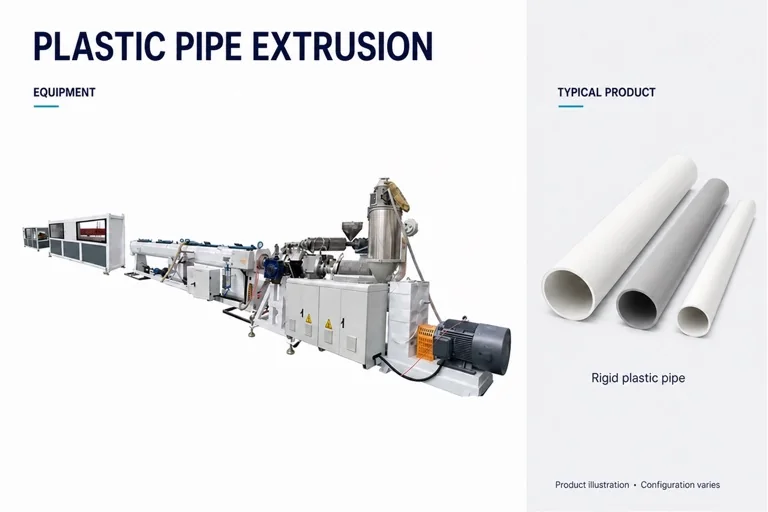
Choosing a plastic pipe extrusion line starts with the finished pipe. Resin family, pipe structure, size range, wall requirement, joint design, target output and downstream handling determine the equipment scope together. A machine name or maximum diameter alone is not enough to compare proposals.
This guide gives buyers a practical sequence for defining a pipe project before requesting quotations. It does not prescribe a universal machine model or output. The final proposal should be tied to the buyer’s product drawing, material and agreed acceptance method.
1. Define the pipe before the machine
Prepare a product table for every pipe family you expect to make. Record the outside diameter, wall or dimension series, length or coil format, colour, layer structure, surface requirement and intended application. Add a drawing, applicable product requirement or physical sample when available.
Separate the complete range from the priority products. The priority products are the sizes and constructions that should control the initial tooling, output discussion and factory acceptance test. This prevents a broad catalogue range from hiding the products that matter most to the investment.
2. Match the process to the resin and formulation
PVC or CPVC rigid pipe, PE pressure pipe, PP or PPR pipe, reinforced hose and structured-wall pipe can require different feeding, screw, die, calibration, cooling and downstream arrangements. State the resin grade and formulation information that may affect processing. Identify recycled content, filler, colour concentrate, reinforcement and moisture-control needs when relevant.
Do not assume that two lines with similar extruder names are equivalent. Ask how the proposed process relates to the actual material, pipe structure and required production window.
3. Choose the forming and downstream method
| Finished pipe requirement | Downstream questions to confirm |
|---|---|
| Rigid smooth pipe | Calibration method, cooling length, haul-off, cutting, stacking and socket or belling needs |
| Flexible hose | Reinforcement or layer process, cooling, pulling, coiling and coil-change method |
| Corrugated pipe | Profile tooling, mould blocks, forming, cooling, cutting or winding and product support |
| Wound or structured-wall pipe | Forming sequence, winding control, cooling, cutting and heavy-product handling |
| Multilayer pipe | Material dosing, layer arrangement, die design, layer checks and line synchronization |
Printing, marking, online measurement, inspection and packing should be defined as functions with a required result. A proposal should state which functions are included, optional or supplied by the buyer.
4. State output on a testable basis
Connect each output target to a named product, material and operating condition. A production rate for one small pipe should not be applied to the entire size range. Ask whether the quoted figure represents extruder output, line speed, acceptable finished product or another basis.
For comparison, require every supplier to state the reference product, tooling, cooling conditions, downstream format, measurement period and product acceptance checks behind the proposed rate. Record start-up scrap and rejected product separately when the acceptance plan requires it.
5. Compare the complete equipment boundary
- Material loading, drying, mixing, dosing and feeding
- Main extruder or co-extruders and control scope
- Die, head, calibrators, moulds and size-change parts
- Calibration, vacuum, cooling and temperature-control equipment
- Haul-off, forming, cutting, coiling, stacking and product handling
- Marking, measurement, inspection and packing functions
- Spare parts, documents, trial materials and project services
Use the same boundary when comparing quotations. A lower total can simply mean that tooling, utilities, auxiliaries or downstream functions are excluded.
6. Check factory conditions before layout approval
Provide the local voltage, frequency and phase, available power, cooling-water supply and return conditions, compressed air, ambient conditions, floor space, door size and lifting access. Show the intended direction of material flow and finished-product removal.
The longest product, cutting method, coil size and storage plan can affect the usable layout as much as the extruder. Reserve safe operating aisles, maintenance access and space for tooling and future product changes.
7. Plan evidence and acceptance before ordering
Agree which product will be demonstrated, which material will be used and what will be measured. The acceptance record may include dimensions, wall or profile, appearance, length or coil format, operating settings and acceptable output over a stated period. Identify tests that require later laboratory work or site commissioning.
Ask for a clear document list covering the agreed line scope, utility interfaces, operating information, spare parts and open items. The factory acceptance test checklist can help organize this step.
Information to send for line selection
- Pipe drawings, product requirements and sample photos
- Resin, formulation and recycled-content information
- Complete size range and priority products
- Wall, layer, reinforcement, profile and joint requirements
- Target output for each priority product
- Cut length, coil, socket, marking and packing requirements
- Factory utilities, layout and destination
- Required trial, measurement and acceptance records
Frequently asked questions
Can one pipe extrusion line make every material?
Do not assume it can. Material behaviour, screw and die design, calibration, cooling and downstream equipment must match the defined products. Ask the supplier to state the supported products and required change parts in writing.
Is maximum diameter enough to select a line?
No. Wall range, resin, pipe structure, output, tooling, cooling and handling can change the required equipment. The priority product table is a better basis than one maximum number.
What should be confirmed before requesting a final quotation?
Confirm the product drawing, material, size and wall range, output basis, included tooling, downstream functions, factory utilities, destination and acceptance method. Use the quotation checklist to keep proposals comparable.
Discuss your pipe extrusion project
Send Mac Lee the pipe drawing, resin, size and wall range, priority products, output target, downstream format and factory utilities. We will use those inputs to discuss the equipment boundary.
Browse plastic pipe extrusion lines · Open the quotation checklist · Plan the factory
Explore common pipe and hose projects
The process route changes with the finished product, even when several projects are described as pipe or hose extrusion. Use the links below to identify the closest application, then prepare the product information that controls the line discussion.
Pressure, plumbing and irrigation pipe
- PE pipe extrusion line: send the pipe application, resin grade, diameter and wall range, coil or straight-length format, and the product used for the requested output basis.
- PP/PPR pipe extrusion line: define the material, pipe series, dimensional range, colour or layer requirements, cutting and stacking format, and applicable product checks.
- Drip irrigation pipe extrusion line: provide the emitter or outlet concept, pipe dimensions, coil requirement, material, target production basis and the inspection method expected for the finished irrigation product.
Flexible hose and application-specific tube
- PVC garden hose extrusion line: state the layer structure, reinforcement if required, inside and outside dimensions, colour, coil format and product tests.
- PP steel-wire telescopic tube production line: send the tube profile, steel-wire arrangement, extension and recovery requirement, end connection, finished length and packing method.
- Dental saliva suction tube extrusion line: define the tube construction, material, dimensions, flexibility, end format, hygiene-related production requirements and the buyer’s own acceptance method.
Drainage and structured-wall projects
- Perforated drainage hose production line: provide the corrugated profile, perforation pattern, dimensions, coil length, material and drainage application.
- HDPE large-diameter winding pipe extrusion line: send the product standard or drawing, wall structure, joint design, size range, stiffness basis and factory handling plan.
If the application is still uncertain, start with the finished-product photograph or drawing rather than choosing a machine name. Mac Lee can use the product, material, dimensions, destination and factory conditions to identify the relevant equipment family before a detailed quotation is prepared.