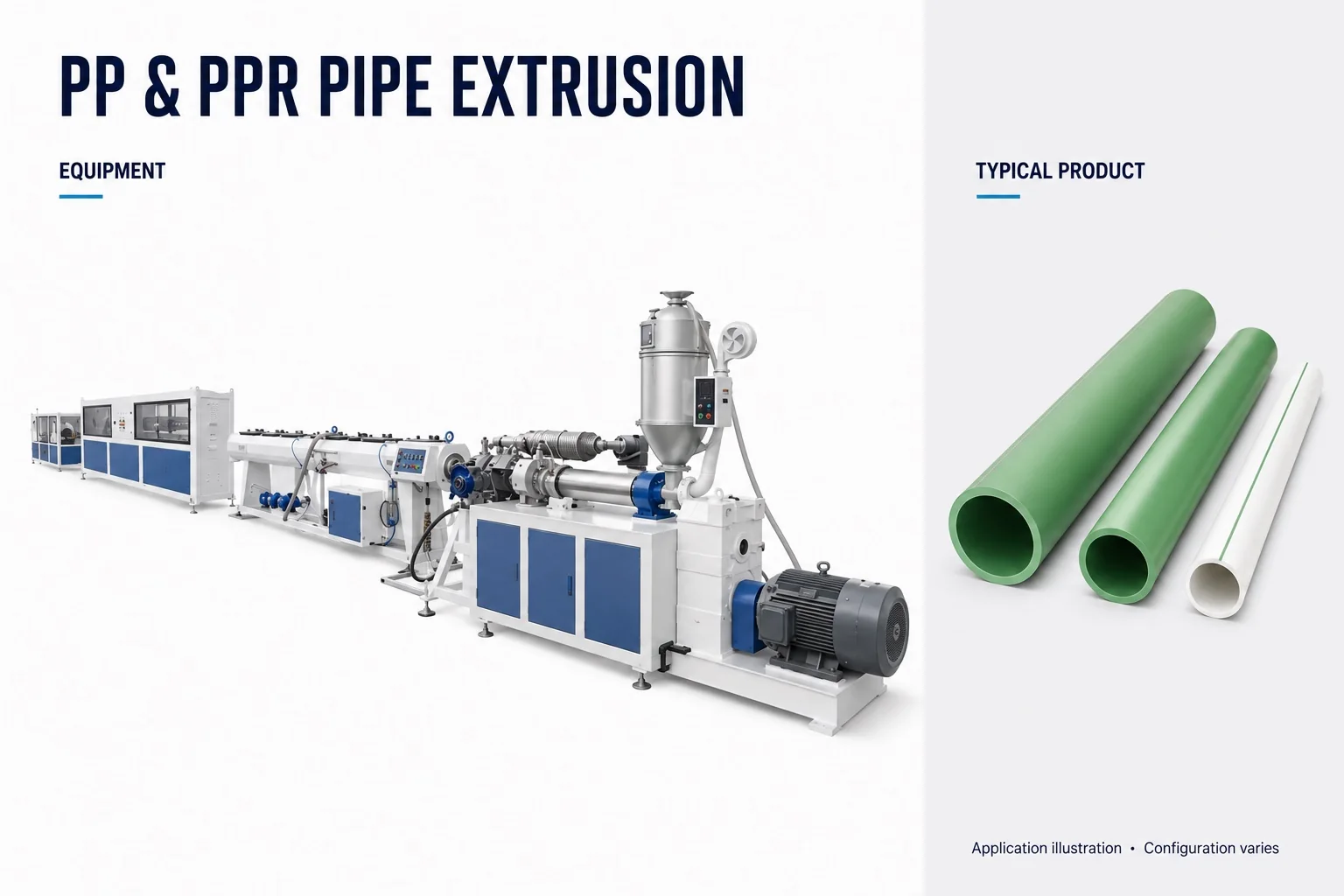
A PP or PPR pipe extrusion line should be configured from the required pipe standard, material grade, dimensions and layer structure. RUNNING MACHINE helps buyers organize these inputs and define a practical equipment scope for extrusion, sizing, cooling, haul-off, cutting and finished-pipe handling.
Projects may involve single-layer pipe, visible stripes or a multi-layer construction. These choices affect the number of extruders, die design, material feeding and process control.
Typical line scope
- Material feeding and preparation equipment as required
- Main extruder and optional co-extruder
- Pipe die, sizing sleeve and change tooling
- Vacuum sizing and water-cooling sections
- Haul-off and cutting units
- Stacker or other finished-pipe handling
- Optional marking, measurement and auxiliary equipment
Information needed for an accurate proposal
- PP or PPR grade and supplier data available
- Pipe use and applicable standard
- Complete outside-diameter and wall-thickness range
- Single-layer, striped or multi-layer structure
- Color and marking requirements
- Standard pipe length and packaging method
- Target output or production schedule
- Factory voltage, frequency and phase
- Cooling-water supply, ambient conditions and compressed air
- Workshop dimensions and existing equipment
Comparing proposals
Check that each proposal covers the same size and wall range, layer structure, tooling quantity, cooling arrangement, finished-pipe handling, auxiliary equipment and installation boundary.
Frequently asked questions
Can the line make multi-layer PPR pipe?
The equipment scope can be discussed for a defined multi-layer structure. Send the number of layers, material for each layer, thickness distribution and any color or stripe requirement.
How many sets of tooling are required?
That depends on the selected size range and changeover plan. List the priority pipe sizes and expected production mix so tooling can be quoted transparently.
Discuss your PP or PPR pipe project
Send Mac Lee the standard, resin, diameter and wall range, layer structure, output goal and factory conditions.
View all plastic pipe extrusion lines · Quotation checklist · Pipe line selection guide
Define the PP or PPR pipe construction first
A PP or PPR pipe extrusion line proposal needs a clear product basis: material grade, pipe application, drawing or standard, outside-diameter and wall range, layer structure, colour or stripe and finished length. If the product is multilayer, identify the material and intended thickness distribution for every layer. This information lets the supplier explain the extrusion arrangement and tooling without assuming that one configuration covers unrelated pipe constructions.
Compare change parts, controls and downstream scope
Ask suppliers to list the dies, sizing sleeves and other change parts included for the proposed size range. The quotation should also separate feeding, main extrusion, co-extrusion, sizing, cooling, haul-off, marking, cutting and stacking. State which product dimensions and appearance points will be recorded during a trial, and connect every requested output figure to a defined material, pipe size, wall and stable test period.
- Production mix: identify the priority pipe sizes and expected changeover sequence.
- Layer design: provide the number of layers, material for each layer, colour or stripe and target distribution.
- Marking and cutting: define printed information, cut length and finished-pipe handling.
- Utilities and layout: provide voltage, water conditions, compressed air and the usable installation space.
- Documentation: request a clear list of manuals, electrical drawings, tooling records and spare-parts information included with the project.
If the planned product mix includes several constructions, ask the supplier to describe the changeover boundary for each one. Record which tooling, material paths and operating adjustments are required so the comparison reflects the actual production plan.
Prepare a PP or PPR pipe enquiry
Use the quotation checklist to align the commercial and technical boundaries and the factory acceptance checklist to define the test. Send Mac Lee the material grade, standard or drawing, diameter and wall range, layer design, marking, cut length, output basis, destination and factory conditions.