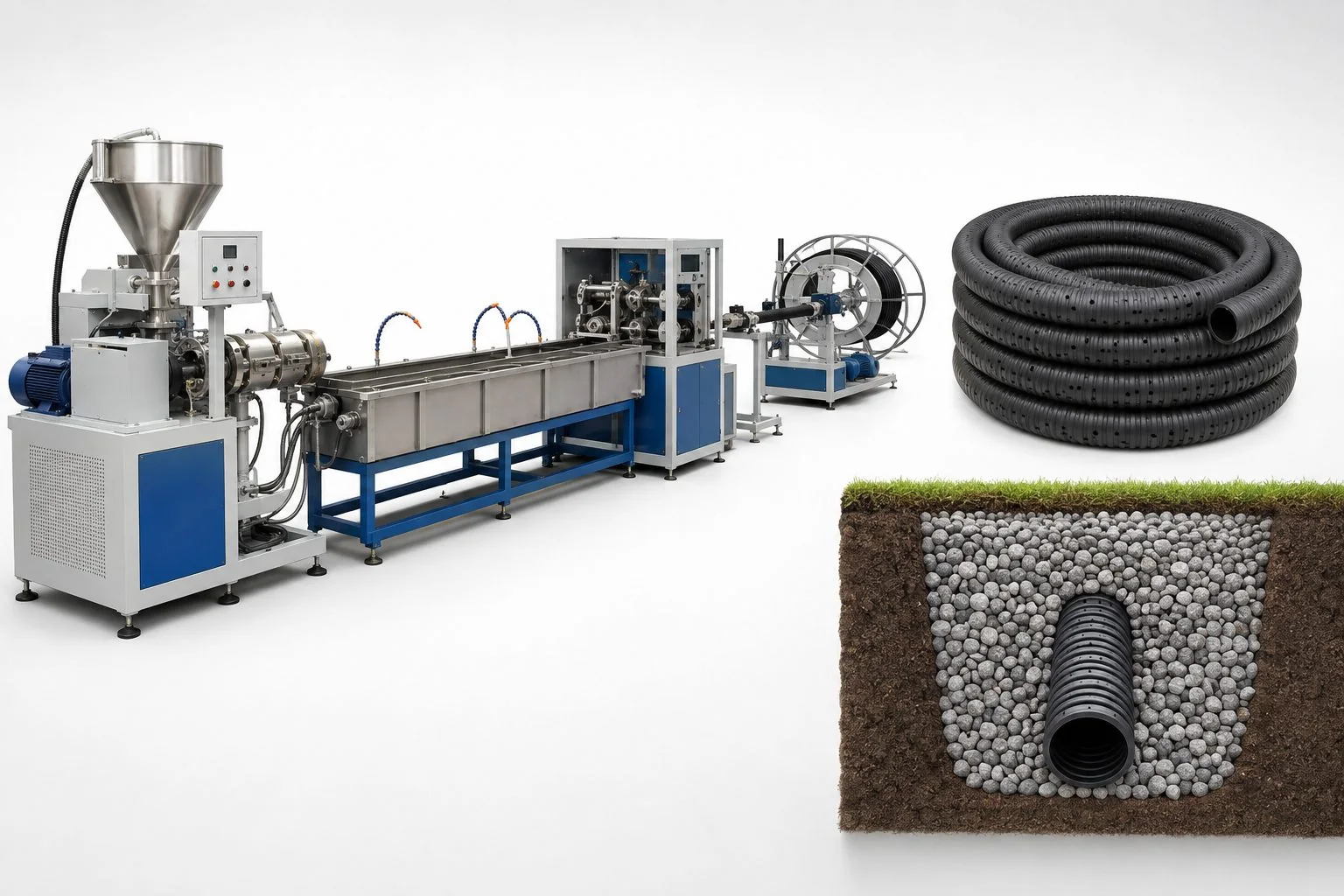
A perforated drainage hose project combines tube or corrugated-hose forming with a controlled hole pattern. Material behavior, wall profile, perforation location, open area, flexibility and coil handling must be defined together.
The word rubber is sometimes used commercially for flexible black drainage hose, but the actual compound and processing route must be confirmed. RUNNING MACHINE bases the equipment discussion on the buyer's material data and finished-hose drawing rather than assuming one formulation.
Typical equipment scope
- Material preparation and feeding for the confirmed compound
- Extrusion and product-specific die or corrugating tooling
- Cooling and profile stabilization
- Inline or downstream perforating equipment
- Hole-debris collection where required
- Haul-off, length control and coiling
- Optional marking and packing interfaces
- Inspection gauges and records defined in the technical agreement
The final station list follows the approved product drawing, material route and buyer-supplied factory conditions. Optional operations should be priced separately so quotations remain comparable.
Information needed for a proposal
- Drainage application and installation cross-section
- Exact polymer, elastomer or compound identification
- Hose drawing, inside diameter, outside diameter and wall profile
- Straight, corrugated or other flexible structure
- Hole diameter, rows, spacing, orientation and allowable burr
- Required open area or flow test with the buyer's method
- Flexibility, compression and handling requirements
- Coil length, coil diameter and packing format
- Target output and planned product range
- Power, cooling, extraction and workshop conditions
Points to confirm before ordering
- Confirm whether perforation occurs inline or after the hose has stabilized, and how hole quality will be checked.
- Provide the real compound data because thermoplastic and cured elastomer routes require different equipment boundaries.
- Define how perforation debris is collected so downstream blockage or contamination can be assessed.
- Agree coil dimensions and minimum bend condition as part of the acceptance sample.
Frequently asked questions
Can one perforator make different hole patterns?
Possible adjustments depend on the perforating method, hose profile and tooling. Supply every pattern drawing so change parts and setup limits can be stated.
Is a flow-rate target enough for quotation?
No. Flow depends on hose dimensions, hole pattern, test pressure and installation. Provide the measurement procedure together with the target.
Can recycled material be used?
The equipment scope can be discussed after the incoming material, contamination, consistency, filtration and finished-product requirements are known. No recycled-content result should be assumed without trials.
Related equipment and planning guides
Corrugated Drain Hose Production Line · Single-Wall Corrugated Pipe Production Line · Plastic Crusher Machine
Discuss your project with Mac Lee
Send the finished-product drawing, material information, planned size range, required downstream operations, target production basis and factory utilities. RUNNING MACHINE will use those inputs to discuss a project-specific equipment boundary.
mac@running-machinery.com · WhatsApp +86 186 6974 6703
View Plastic Pipe Extrusion Lines · Quotation checklist · Factory acceptance checklist