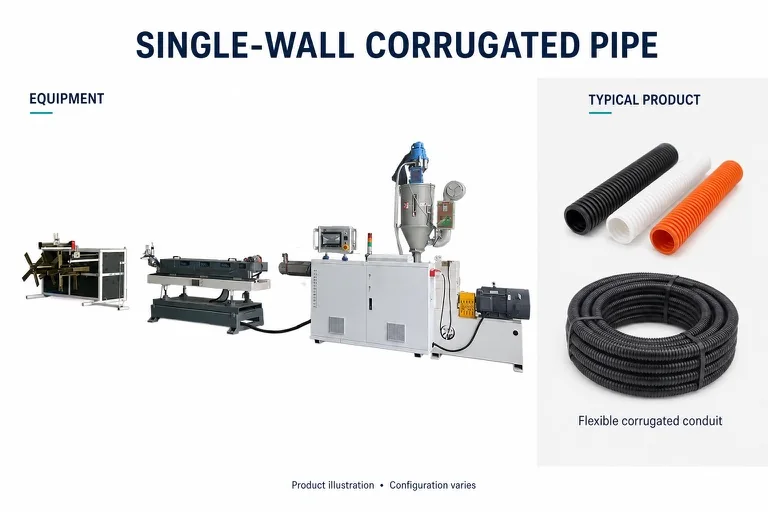
Single-wall and double-wall corrugated pipe machines make products with different cross-sections, performance requirements and downstream workflows. A useful comparison starts with the finished pipe—not with the machine name alone.
This guide helps buyers organize the information needed to compare the two line types. The final configuration still depends on the product drawing or standard, resin, dimensions, stiffness or flexibility requirement, connection method, output basis and factory conditions.
The practical difference is in the finished pipe
| Comparison point | Single-wall corrugated pipe | Double-wall corrugated pipe |
|---|---|---|
| Wall structure | One corrugated wall defines the product profile. | A corrugated outer wall is combined with an inner wall defined by the product design. |
| Typical selection focus | Flexibility, bend behaviour, conduit or hose interface, slit or unslit form, and coil or cut length. | Ring or structural requirement, internal flow path, joint design, straight-length handling, and applicable pipe standard. |
| Downstream questions | Winding, cutting, slitting, marking, end finishing and packing format. | Cooling, haul-off or handling, cutting, socket or joint preparation, inspection and stacking. |
| Project information to send | Material, cross-section, dimensions, application, coil or cut format, and required tests. | Material, pipe standard or drawing, dimensions, stiffness basis, joint form, length and required tests. |
The table is a planning comparison rather than a universal specification. Corrugated products vary by application and market. Use the buyer’s own drawing, sample or governing standard to settle the details.
When a single-wall line is the closer starting point
A single-wall corrugated line is generally the relevant family when the required product has one profiled wall and the project is driven by flexibility, routing, protection or a hose-like function. Examples can include electrical conduit, automotive wire protection, appliance drain hose and other small corrugated tubes. These examples do not replace the actual product definition.
- State whether the tube is slit or unslit and whether a pull wire, connector or finished end is required.
- Provide the profile drawing, outside and inside dimensions, pitch and acceptable dimensional tolerances.
- Define flexibility, bend, compression or other product checks by the applicable method.
- Specify coil size, straight cut length, marking, counting and packaging requirements.
Review the single-wall corrugated pipe machine range and its application-specific pages before requesting a proposal.
When a double-wall line is the closer starting point
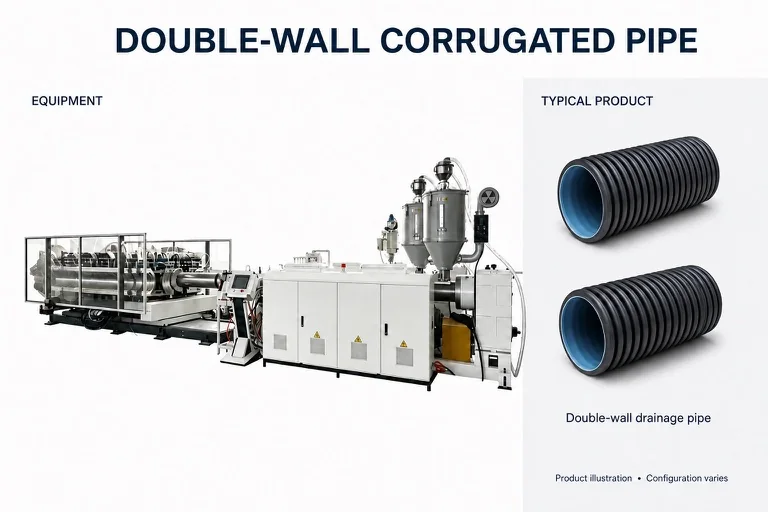
A double-wall line is generally the relevant family when the product design combines a profiled outer wall with an inner wall and the project focuses on structured-wall pipe performance, drainage or duct use, joint design and straight-length handling. The required forming and cooling arrangement must follow the defined pipe rather than a generic diameter label.
- Provide the pipe standard or a complete cross-section drawing, including the joint or socket.
- Define the resin system, dimensions, stiffness or structural basis and product length.
- State how the pipe will be cooled, cut, inspected, moved and stacked in the available factory space.
- Identify any online marking, perforation, socketing or special connection operation that belongs in the project scope.
Review the double-wall corrugated pipe machine range for the general production line, water-cooled configuration and duct application pages.
Compare complete line scope, not isolated machines
Two proposals can use the same line name while including different equipment. Ask each supplier to mark what is included, optional, buyer-supplied or excluded. The comparison should cover material feeding and preparation, extrusion, tooling, forming, cooling, haul-off or conveying, cutting or winding, product handling, controls, spare and change parts, documentation, installation support and trial conditions.
Output also needs a written basis. Record the material, product size and structure, acceptable product condition, measurement period and utilities behind any stated value. This makes competing proposals easier to compare and gives the later factory acceptance test a clearer reference.
Check factory conditions before selecting the line
- Confirm site voltage, frequency and any limits that affect motors, heaters and controls.
- Record cooling-water temperature, quality, pressure, flow and the planned recirculation system.
- Define compressed-air and other utility requirements for the proposed configuration.
- Check the usable building length, width and height together with doors, columns and service access.
- Plan raw-material movement, finished-pipe handling, scrap return, inspection and packing areas.
A short enquiry brief for corrugated pipe equipment
| Input | What to send |
|---|---|
| Finished product | Application, photograph, sample or cross-section drawing |
| Material | Polymer and known formulation or grade information |
| Dimensions | Diameter range, wall structure, profile and tolerance basis |
| Performance | Flexibility, stiffness, connection and applicable test or standard |
| Delivery form | Coil, cut length, socket, marking, packing and handling method |
| Project conditions | Target output basis, voltage, utilities, workshop space and destination |
Frequently asked questions
Can one corrugator make both single-wall and double-wall pipe?
Do not assume that it can. The extrusion, die, forming, cooling and downstream requirements follow the pipe construction and size range. Ask the supplier to confirm the exact products, tooling and change parts covered by the proposed configuration.
Is diameter enough to request a quotation?
No. Diameter alone does not define the wall structure, profile, material, joint, performance requirement, output basis or downstream scope. A drawing, sample or applicable standard makes the quotation more useful.
Should the buyer choose air cooling or water cooling first?
Start with the required pipe, size range, material, output basis and factory cooling-water conditions. The supplier should then explain the suitable forming and cooling arrangement for that defined project.
Send your corrugated pipe requirement
Send Mac Lee the pipe application, material, cross-section, dimensions, connection or coil format, target output basis and factory utilities. We can use those inputs to identify the relevant equipment family and organize a proposal discussion.
Prepare a quotation checklist · Plan the factory acceptance test