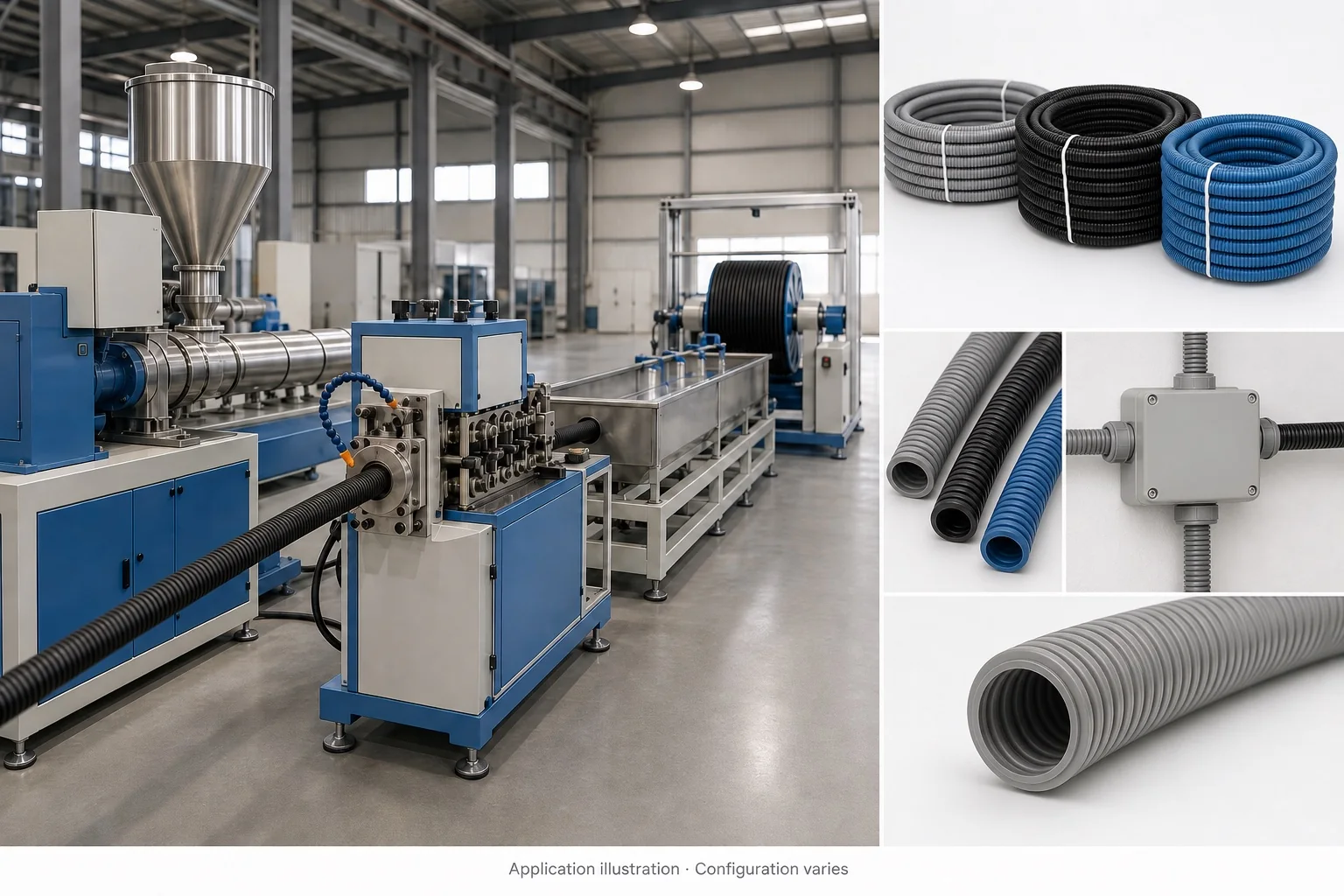
Flexible corrugated conduit projects should start with the installation environment and applicable product requirement. Resin, wall and corrugation geometry, pulling behavior, coil format and dimensional tolerances determine the tooling and downstream scope.
RUNNING MACHINE helps buyers turn those inputs into a clear line discussion covering extrusion, forming, cooling, winding and the required auxiliaries.
Typical equipment scope
- Material feeding or preparation
- Extruder and controls
- Conduit die and tooling
- Corrugator with product-specific mould blocks
- Cooling arrangement
- Length counting and winding
- Optional marking or inspection devices
- Required factory auxiliaries
Information needed for a proposal
- Installation use and product standard
- Resin and color
- Complete size and wall range
- Corrugation drawing or reference sample
- Required coil length and coil dimensions
- Pulling or mechanical test requirements
- Target production rate
- Marking and packaging needs
- Local power and utility conditions
Frequently asked questions
Can different conduit sizes use one production line?
The possible range depends on extruder capacity, corrugator design, mould blocks and tooling. Provide the full product table so change parts can be identified.
Is a winder always required?
It depends on the finished product and packaging method. State whether the conduit is supplied in coils, short lengths or another format.
Can product marking be included?
Yes, when the marking content, position and method are defined in the inquiry.
Related corrugated pipe applications
Single-wall corrugated pipe line · Corrugated drain hose
Discuss your conduit project
Send Mac Lee the conduit standard, material, size range, profile drawing, coil format and factory conditions.
View Single-Wall Corrugated Pipe Machines · Quotation checklist · Pipe line selection guide